Materials & Making
Organic Cotton Textiles: What Certifications Reveal About Materials and Production
A label can tell you something important about a textile’s journey. It cannot tell you everything. Understanding what organic and social certifications actually cover—and where their boundaries lie—makes it easier to read a claim without asking it to do more than it can.
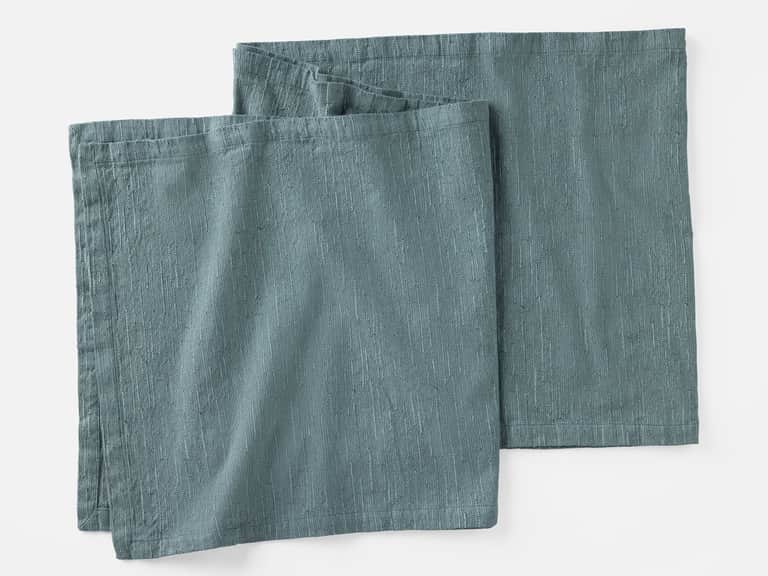
Cotton has a talent for seeming simple. It is soft, familiar, and available in a bewildering range of forms: crisp percale, brushed flannel, sturdy canvas, smooth sateen. A finished textile may arrive at the home as a table runner or a baby’s sleep sack, carrying only a small label’s worth of information about the fields, mills, and workshops behind it. In the space between the cotton plant and the finished object, however, lie many decisions—about farming, processing, labor, dyeing, sewing, and transport.
Certifications try to make some of those decisions legible. For organic cotton, the Global Organic Textile Standard, usually shortened to GOTS, is among the best-known frameworks. Fair Trade Factory certification, when claimed alongside a product, points to a different set of questions about working conditions and factory practices. These labels can be useful precisely because they are not interchangeable: one does not stand in for the other, and neither is a complete account of a product’s environmental or social life.
The habit worth cultivating is not suspicion for its own sake, nor automatic trust in a seal. It is attention. What standard is named? What does it cover? Does the claim apply to the fiber, the finished article, the factory, or some combination? And what information remains outside the frame?
From a plant to a finished textile
Cotton’s transformation is a chain of linked stages. The crop is grown and harvested; fibers are separated from seeds, cleaned, spun into yarn, woven or knitted into cloth, and then finished. Depending on the textile, finishing may involve washing, bleaching, dyeing, printing, softening, or other treatments. The cloth is cut and sewn into its final form. A phrase such as “organic cotton” may sound like a description of the whole chain, but its precise meaning depends on the standard and the claim being made.
At the agricultural end, organic production standards generally address how the crop is grown, including restrictions on certain synthetic inputs and requirements for agricultural practices. But the word “organic,” by itself, does not describe every subsequent operation. A fiber can be grown under an organic standard and still pass through a complex manufacturing system involving multiple businesses and countries. A finished product certification is more informative than a broad materials statement because it can address additional stages and require the chain of custody to be documented.
This distinction is why readers should look for the name of a standard rather than relying only on adjectives such as “natural,” “responsible,” or “earth-friendly.” Those words may express a brand’s intentions, but they do not, on their own, tell a reader which requirements were applied or how compliance was checked.
What GOTS is designed to show
GOTS is a textile-processing standard for products made with organic fibers. Its scope reaches beyond the farm: it includes requirements for processing and manufacturing, and it establishes criteria related to chemical inputs, environmental management, and labor conditions in the facilities covered by the standard. Certification involves inspection and documentation across relevant stages of the supply chain, rather than simply accepting a maker’s description of a fiber.
The exact wording of a claim matters. GOTS has product categories and certification rules, and not every product described as containing organic cotton is necessarily certified as a GOTS product. A claim that a textile is “made with organic cotton” is not automatically the same as a claim that the finished item is GOTS certified. When a product listing names GOTS, readers can look for whether the claim clearly applies to the item itself and whether the seller provides further certification details.
The standard is also not a promise that every impact has disappeared. Certification does not mean that a textile required no water, energy, transport, or land. It does not establish that a product will last forever, that every worker across every related activity has identical conditions, or that the finished article is free from every substance a particular consumer might wish to avoid. Standards define requirements within a particular system; they do not abolish the complexity of production.
A useful way to think about GOTS is as a map with a marked route. It can help identify certain checkpoints and rules along the textile chain. A map is valuable, but it is not the landscape itself. It does not tell you everything about a company’s choices, the durability of a seam, or how the item will be used and cared for over time.
What a fair-trade factory claim adds
Organic certification and fair-trade certification answer different questions. Organic standards focus substantially on fiber and textile production requirements; a Fair Trade Factory claim concerns social conditions in a manufacturing setting. Depending on the program and its current rules, such certification may address matters including worker protections, workplace practices, and mechanisms intended to support workers. The name alone is not enough to establish every detail: the relevant program’s own criteria should be consulted.
The distinction is more than technical. A cotton crop can meet organic requirements while the circumstances of garment or textile workers remain a separate issue. Conversely, a factory program can address workplace conditions without making a claim about how the cotton was cultivated. When a product carries both GOTS and Fair Trade certification claims, the labels may offer complementary information—but they should still be read as separate certifications with separate scopes.
Nor should a fair-trade label be treated as a universal guarantee of fairness at every point in a supply chain. Certification applies according to defined rules, eligible facilities, and verification processes. It cannot be expanded by assumption to cover farms, transport companies, or subcontractors unless those parts are explicitly included. A careful reader asks not only, “Is it certified?” but also, “Certified by whom, against what standard, and for which part of production?”
A product as a case study
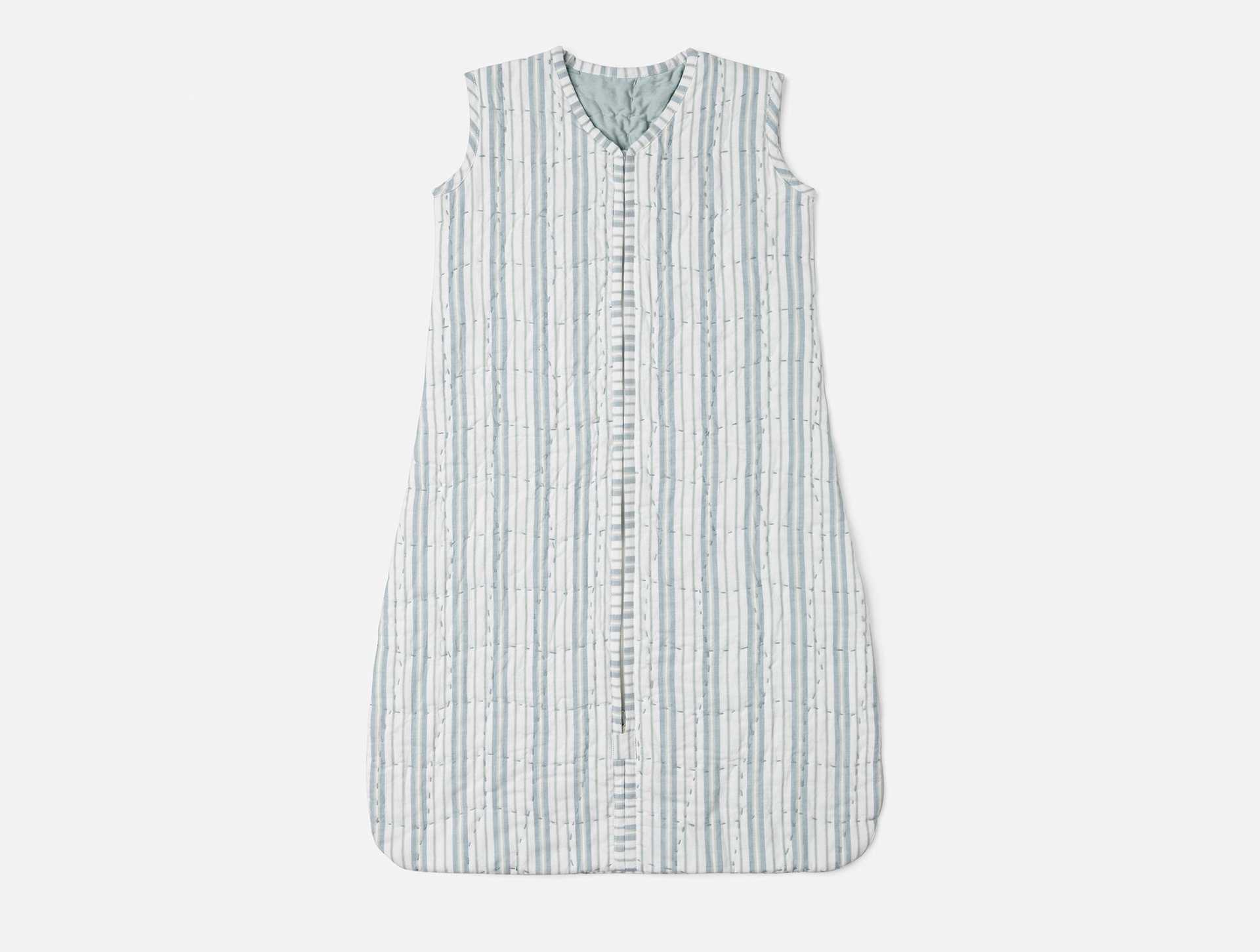
Consider Coyuchi’s Pebbled Handstitched Organic Snuggle Sack, described as being made from 100 percent certified organic cotton sateen. Its product information identifies the cotton as grown and woven in India and lists both GOTS and Fair Trade certification. It also describes a covered front zipper, arm openings, and handstitched embroidery. Those details do not all mean the same thing: the certification claims concern standards, the origin statement describes parts of the material’s journey, and the construction notes describe the finished object.
Taken together, they offer a more substantial account than the phrase “organic cotton” alone. The stated origin gives a reader some geographic context; the construction description explains how the item is assembled; and the named certifications point toward external requirements and verification. Yet even this combination leaves reasonable questions. Which facilities are covered by each certification? Is the finished product certified under the relevant GOTS category? What does the Fair Trade program require at the factory? The product description is a starting point, not a substitute for the standards’ own documentation.
The care instructions matter, too. This item is described as machine washable on a cold, gentle cycle, with low tumble drying. Care is not a certification issue, but it is part of a textile’s practical life. A product that is used carefully and remains useful for a long time may avoid some of the impacts associated with frequent replacement. No label can guarantee that outcome; design, construction, household habits, and repair possibilities all contribute.
The supply-chain questions labels cannot answer alone
A certificate compresses a great deal of information into a small symbol or line of text. Compression is useful, but it can create a false sense of completeness. Readers evaluating responsible textile production can look beyond the seal and seek clear answers to several practical questions:
- What exactly is certified? Is the claim about the raw fiber, a particular processing stage, the finished product, or a manufacturing facility?
- Which standard and certification body are named? Specific names make it possible to find the rules and understand what is being assessed.
- Where did the material and manufacturing take place? Country-of-origin details can help establish context, though geography alone does not prove responsible or irresponsible production.
- Are the claims consistent? A product page, label, and brand explanation should not describe the same certification in conflicting ways.
- What information is missing? A clear account of fiber sourcing may still leave dyeing, finishing, subcontracting, or labor arrangements unexplained.
These questions are not a demand that every product listing become a research paper. They are a way of distinguishing evidence from atmosphere. Earth-toned packaging, images of fields, and language about care for the planet may help create a brand’s mood; none of them functions as independent verification. A standard, by contrast, has published criteria that can be examined, even if understanding them takes more effort than glancing at a tag.
Marketing language and the limits of a seal
Textile marketing often draws on words whose meanings are elastic. “Eco-conscious” may describe a general intention. “Sustainable” can refer to many different environmental or social priorities, but without specifics it is difficult to evaluate. “Organic” has more defined meaning when linked to a recognized certification, yet the scope of the claim still matters. The responsible reader does not have to reject such language outright; it is enough to ask what evidence gives it substance.
Certifications also differ in transparency and coverage. Some focus on the fiber; others on chemicals, facilities, labor, animal welfare, or a product’s environmental footprint. A label that answers one question should not be treated as an answer to all the others. For example, a fiber certification cannot by itself establish that a textile is exceptionally durable, while a factory certification does not necessarily establish the agricultural practices used to grow its cotton.
This is why a cluster of claims can be more informative than a single attractive word, provided each claim is specific and verifiable. It is also why an honest description of limitations can build more trust than a sweeping claim of perfection. Responsible production is rarely a matter of one miraculous material; it is a set of choices, each with its own evidence and consequences.
Material facts beyond certification
Certification is only one dimension of evaluating a textile. Fiber composition can indicate whether a fabric is pure cotton or a blend. Weave and construction affect feel, strength, and how the article behaves in use. A sateen weave, for instance, is associated with a smooth surface, while stitching and seam finishing influence how a sewn product holds together. These are material and construction facts, not ethical conclusions, but they help readers judge whether an item is suited to its purpose.
Care instructions are another small but revealing part of a product’s life. Washing temperature, drying method, and the need for special treatment can affect convenience and longevity. A textile that is easy to care for may be used more often; one that requires careful handling may still be worthwhile, but its upkeep should be understood before purchase. The useful question is not simply whether a fabric is certified, but whether its certified material, construction, and care requirements make sense for the way it will actually be used.
Durability is especially difficult to reduce to a seal. It depends on fiber quality, yarn, weave, finishing, workmanship, frequency of use, and care. Some makers publish repair guidance or details about expected use; others do not. Certification can establish that certain rules were followed at covered stages, but it does not measure the life of every stitch in a household.
A practical reading of the label
When faced with an organic cotton claim, begin with the exact wording. If a product says “GOTS certified,” look for whether that certification refers to the finished article and whether the seller offers a certificate number or other documentation. If it says “made with certified organic cotton,” ask whether the finished textile is certified under a processing standard or whether the claim concerns the fiber alone. If Fair Trade Factory certification is named, find the program’s description of its requirements rather than assuming that the phrase covers every worker and supplier in the chain.
Then separate the evidence into categories. Fiber origin answers where cotton was grown. Manufacturing origin describes where it was processed or made. Certification identifies the rules and verification associated with particular stages. Construction explains how the item is put together. Care guidance describes how to maintain it. When those categories are presented distinctly, a product becomes easier to understand—and harder to oversell with a single green-sounding phrase.
Finally, allow for uncertainty. Supply chains are intricate, and public-facing product pages often offer a summary rather than a full audit trail. A lack of detail does not automatically prove a bad practice; it does mean that a reader has less evidence. Similarly, a certification is meaningful without being a guarantee of ethical perfection. Good judgment occupies that middle ground: neither cynical nor credulous, attentive to what is documented and candid about what is not.
What a certification is—and what it is not
An organic cotton certification can turn an otherwise vague claim into a more accountable one. GOTS can indicate that requirements extend across defined textile-processing stages, while a Fair Trade Factory claim points toward a separate framework for workplace practices. Product details such as the stated Indian origin of Coyuchi’s cotton, the sateen fabric, and the handstitched construction add context that a seal alone cannot supply.
None of this makes a label a complete biography of a textile. It is closer to a well-marked chapter: useful, specific, and bounded. Read carefully, certifications help consumers distinguish verified standards from broad marketing language and ask better questions about responsible textile production. Read uncritically, they can become decorative shorthand for a confidence the evidence may not support.
The most useful label is therefore not the one that ends the conversation. It is the one that makes a better conversation possible—about how cotton was grown, how cloth was processed, who made the finished object, and what further facts would help us understand it.